


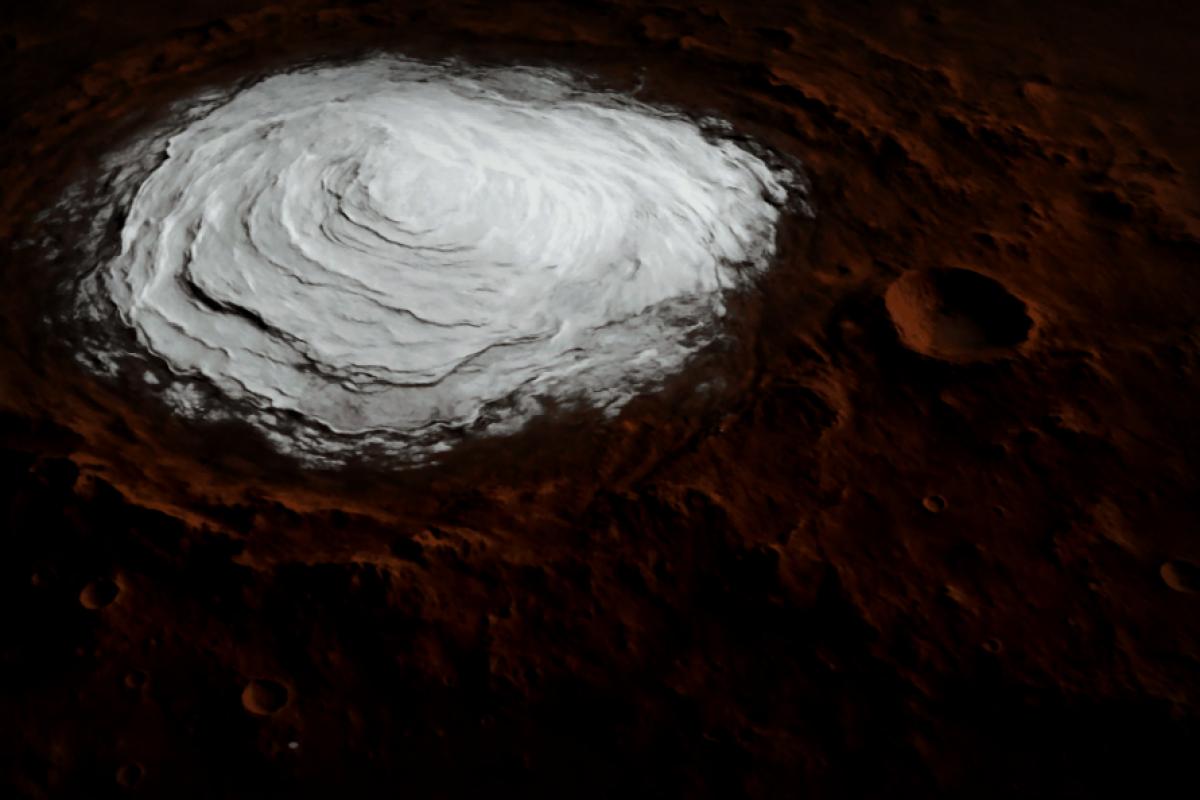
The Mars Reconnaissance Orbiter (MRO) under NASA’s guidance, just delivered exciting news about something strange lurking beneath the icy blanket of the Red Planet. Back in 2018, a different spacecraft detected a bright radar signal that hinted at the possibility of a hidden lake beneath the polar ice. Given the connection between liquid water and the potential for life, this sparked a flurry of worldwide interest.
New Insights into a Martian Puzzle Beneath the Ice
Thanks to a groundbreaking radar method, researchers now suggest a fresh angle on this intriguing signal beneath Mars’ southern ice cap. Instead of confirming the existence of a reservoir of watery wonder, improved radar techniques indicate the feature detected was likely a patch of rock or dust that reflects radar waves exceptionally well. This revised understanding provides valuable insight into the makeup of the ice cap and its subsurface materials.
Located under a staggering 1,500 meters of ice, previous investigations yielded no extraordinary results. However, with enhanced radar configurations, scientists finally captured a rather weak signal—not the bold reflection one would typically expect from a chunk of liquid water tucked away under heavy ice. The intense reflections spotted back in 2018 probably came from a uniquely flat layer of rock or possibly ancient lava lurking beneath the ice.
The latest Mars missions revealed fast-moving object 3I/ATLAS—astronomers are astonished by its immense 1,500 km-wide coma.
The landscape at Mars’ south pole is brimming with ridges, craters, and ragged terrain, providing the perfect backdrop for diverse underground features. Thus, a fully smooth surface would stand out starkly against the chaotic landscape and could clarify why radar readings have been inconsistent. In light of this recent discovery, the hypothesis of a lake under the polar dome seems increasingly distant, yet the exact nature of this elusive feature is still clouded in mystery.
A Game-Changer for Radar Observations
The major breakthrough in this latest research stemmed from an innovative technique known as a “very large roll.” Since the MRO’s radar apparatus is located on its rear, sometimes its view is obstructed, causing limitations in its ability to examine below the ice.
In response, engineers devised a roll maneuver, rotating the spacecraft 120 degrees in space. This new position allowed the radar to directly target the surface, pushing robust pulses through the ice and probing the globe beneath.
The meticulous planning surrounding this maneuver was crucial for the orbiter’s safety, but the results were significant. As the spacecraft executed this maneuver on May 26, the radar signals penetrated far deeper than ever before, finally uncovering clues about the location in question.
Ridley Scott’s Best in Years – Why The Martian Is More Than Just a Sci-Fi Thriller
Unfortunately, what MRO reported did not line up with the vivid lake scenario by displaying a weaker signal instead. When the orbiter surveyed a nearby section of the polar ice, there was a complete absence of activity, suggesting that the instance of the bright reflection from before might be exceptionally rare. This peculiar offering could be the result of a smooth layering below the surface instead of water.
With the intelligence gained from this advance radar technique, scientists now have a powerful approach for exploring beneath Mars’ chilly polar regions, enabling them to map out hidden features with supreme clarity. This is especially pivotal in zones that weren’t reachable in prior years.
Equally telling is how remarkable older missions like MRO—orbiting Mars since 2006—can yield breakthrough discoveries simply through fresh methodologies. By adjusting the craft’s orientation, SHARAD, its radar instrument, performed spectacularly in revealing concealed insights that remained under wraps for nearly two decades.
Unlocking More Mysteries on the Red Planet
This revamped radar method not only assists in deciphering the polar ice terrain but also sets the stage for analyzing other quirky Martian locales. A prominent area of interest is Medusae Fossae, a colossal formation near Mars’ equator that almost entirely evades radar signals. Some scientists suspect ice deposits might nestle down below, while others theorize it could be of volcanic ash origin.
NASA team stunned by unexpected rock discovery—an unusual iron-nickel boulder on Mars may have originated from deep space.
Thanks to the pioneering operations of the MRO team, employing the very large roll technique can unveil those hidden signals beneath polar ice. They’re gearing up for similar ventures to explore enigmas like Medusae Fossae and other unknown territories across Mars. Better radar depth could help researchers map subterranean layers throughout the planet, unveil buried structures, and comprehend Mars’ geological history.
While speculation continues and debates over the bright 2018 signal persist, these latest outcomes showcase how advanced radar techniques bring scientists closer to understanding the nuances nestled within Mars’ polar ice, as well as revealing the hidden secrets waiting just below the surface. Every scan peels back more layers of the Red Planet’s mystery, making it just a touch more human.
The post Mars mystery cracked open after NASA’s dramatic radar test pierces 1,500 meters of polar ice appeared first on Spacetech Times.