


Later today, at 9 p.m. Paris time, all eyes will be on NASA as they unveil their latest findings and images of the enigmatic object known as 3I/ATLAS, cruising through our Solar System.
This intriguing object is just the third interstellar comet to be identified, hailing from a distant star system. Naturally, this has sparked a whirlwind of fascination online, with some theorists even speculating about the possibility of it being a remnant from an alien civilization.
However, experts pour cold water on these notions, emphasizing there’s no proof to suggest such origins. The scientifically accepted viewpoint is that 3I/ATLAS is simply an ancient, frigid rock and ice fragment that has drifted through the cosmos for billions of years.
How 3I/ATLAS Came to Be Known
This peculiar comet was first spotted on July 1, 2025, by a network of robotic telescopes called ATLAS, which actively scans the sky for dynamic objects.
What began as a faint flicker in the distance was quickly discerned to be something not belonging to our Solar System after additional observations.
This discovery gained momentum when Avi Loeb, an astrobiologist from Harvard, suggested its similarities to the initial interstellar visitor ‘Oumuamua, which he proposed might have been an extraterrestrial probe.
While most scientists sided against Loeb’s theory, his provocative ideas ironically highlighted 3I/ATLAS, boosting interest across the scientific community.
Insights Gained by Scientists
By monitoring its trajectory closely, researchers have established that 3I/ATLAS is following a one-way flight path through our Solar System, not in any kind of orbit. It’s speeding away into the depths of space.
Furthermore, it travels at an astounding velocity, far beyond the speed of celestial bodies typically formed near our Sun. This rapid movement implies its origin far from our solar region.
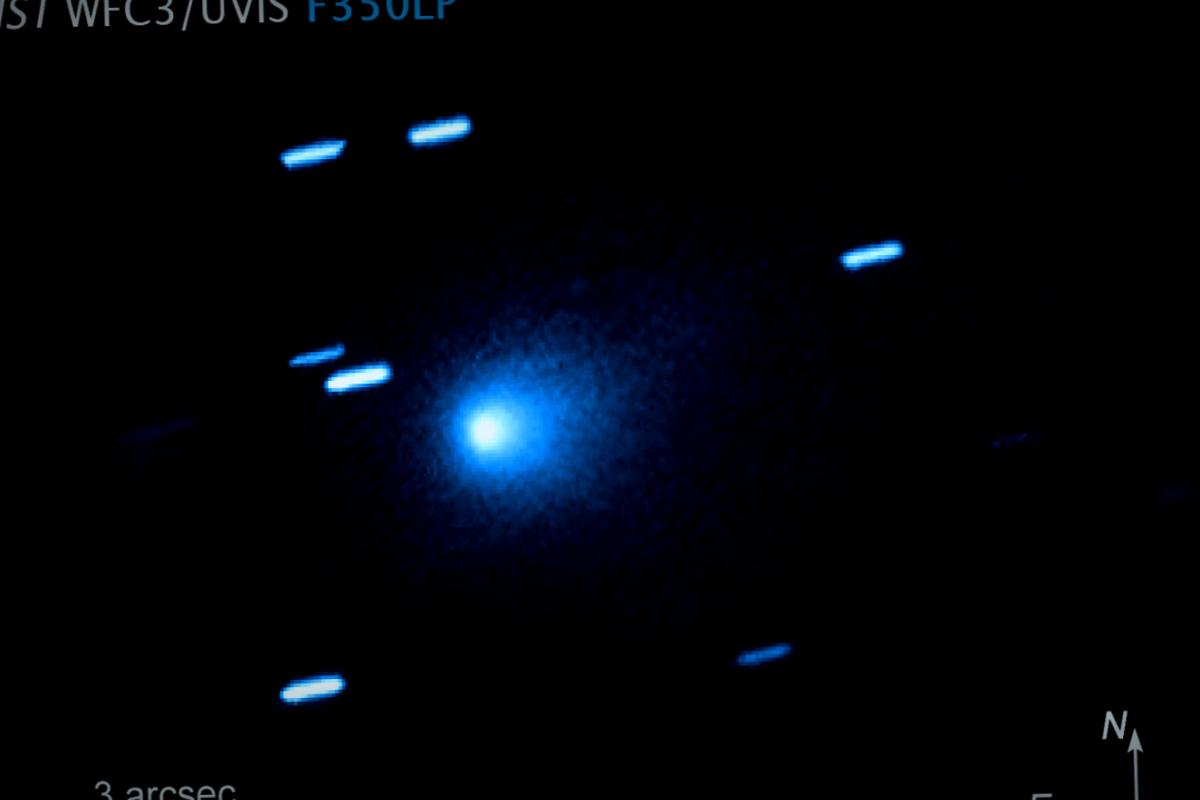
Both the Hubble and the James Webb telescopes have taken a good look at this cosmic wanderer.
Preliminary research has indicated that this comet has an unusual amount of carbon dioxide compared to its Earth-near counterparts, hinting it may have been formed in an extremely cold environment, possibly around a star dimmer than our sun.
What to Expect from NASA Tonight
During tonight’s live event, NASA is set to share brand-new photos and additional insights that could finally address several burning questions:
- What is the actual appearance of 3I/ATLAS?
- Does it exhibit typical comet behavior?
- Are there any unique characteristics to its shape or tail?
- Could there be any unexpected hints?
While many in the scientific arena anticipate an affirmation that 3I/ATLAS is nothing beyond a standard comet, curiosity remains high—especially given how rare interstellar specimens are.
With everyone eagerly awaiting the reveal, all attention is firmly on NASA tonight to enlighten us about this captivating visitor from another star.