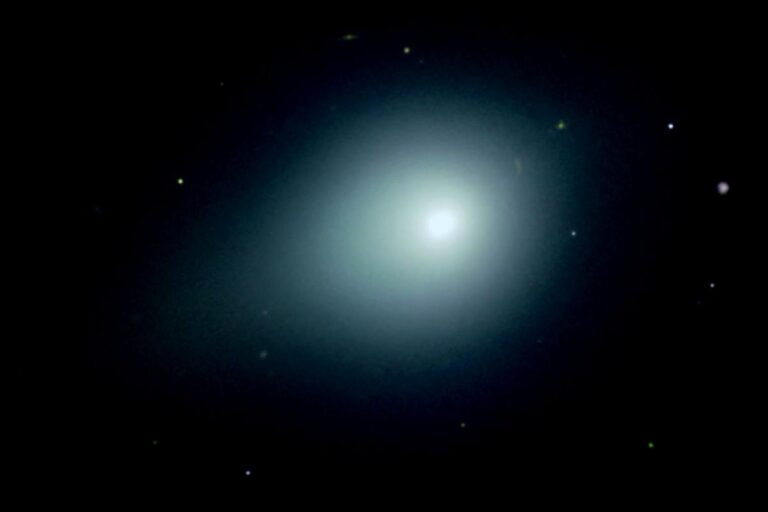



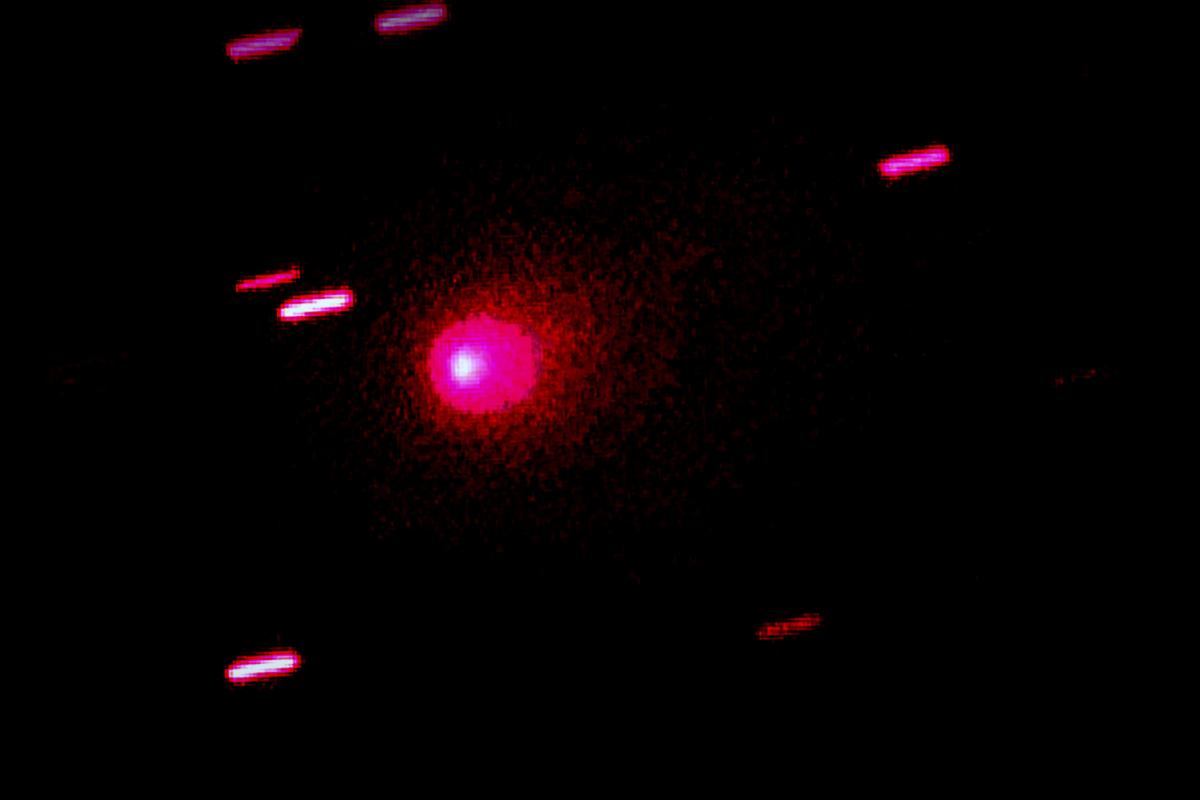
The interstellar object known as 3I/ATLAS is about to get really close to Earth—just 167 million miles away! While that’s still a huge distance, it’s actually a small leap in cosmic terms.
This is a thrilling time for astronomers, as they’ll have the chance to observe this strange visitor up close with both ground and space telescopes. Experts have been keeping an eye on it for months because most believe it’s a comet zooming through our solar system.
NASA’s Hubble Space Telescope first spotted 3I/ATLAS on July 21, and right away, scientists saw something odd. There’s a strange protrusion extending from it—a second tail that strangely points towards the Sun, opposite to the direction conventional comet tails usually take.
This peculiar feature, d the “anti-tail,” might stem from an intensified loss of mass on the Sun-facing side of the object, according to Harvard astronomer Avi Loeb, who shared his insights with Futurism earlier this year. In essence, the larger pieces breaking off the comet don’t react to the Sun’s radiation pressure as smaller particles do, causing them to accumulate on that side.
Even more than a month after its nearest approach to the Sun, the anti-tail remains quite visible. Loeb recently updated his blog to report that an image taken on December 13 by the Teerasak Thaluang telescope in Thailand clearly shows this unusual feature.
According to Loeb, the abundance of images captured since Hubble’s original observations strongly support the idea that this anti-tail is indeed a legitimate physical feature rather than just a trick of perspective.
“The nature of this phenomenon is puzzling because we expect gas and micrometer-sized dust to get pushed away from the Sun,” Loeb pointed out. He emphasized that it usually results in the formation of a tail typical for comets in our solar system.
In a characteristic twist, Loeb isn’t completely ruling out the idea that it could be something more exotic—a potential alien spacecraft. He suggests the possibility that this anti-tail could be a cluster of objects lagging behind 3I/ATLAS due to its unusual acceleration away from the Sun, as he elaborated in a new blog post.
On the other hand, some scientists aren’t buying into that alien theory. They believe that having two tails is actually quite normal for objects like 3I/ATLAS, despite its cosmic origin.
UCLA astronomer and comet specialist David Jewitt commented last month, saying it makes sense that it’s ejecting dust particles towards the Sun. “The hot side of the nucleus creates a situation where typical comet behavior is happening,” he noted.
Astronomer Jason Wright from Penn State also argued against the alien idea, pointing out that similar effects due to large ejected dust grains have been seen before. These can sometimes gather on the sunny side of a comet without being swept away.
Researchers from the European Space Agency chimed in as well, suggesting that this observed tail could simply be a typical dust tail made up of tiny solid particles, yet another familiar aspect of comets.
It’s worth mentioning that even Loeb has expressed various theories about the anti-tail. In his ongoing research, he’s posited that tiny ice fragments shed by 3I/ATLAS evaporate quickly and do not develop into a classic tail.
Regardless, he urges all to “expect the unexpected.” Recognizing the anomalies in cosmic observations could be key to gaining fresh insights into our universe.
For more insights on 3I/ATLAS, tune in to:Mysterious Interstellar Object Nears Earth
“,