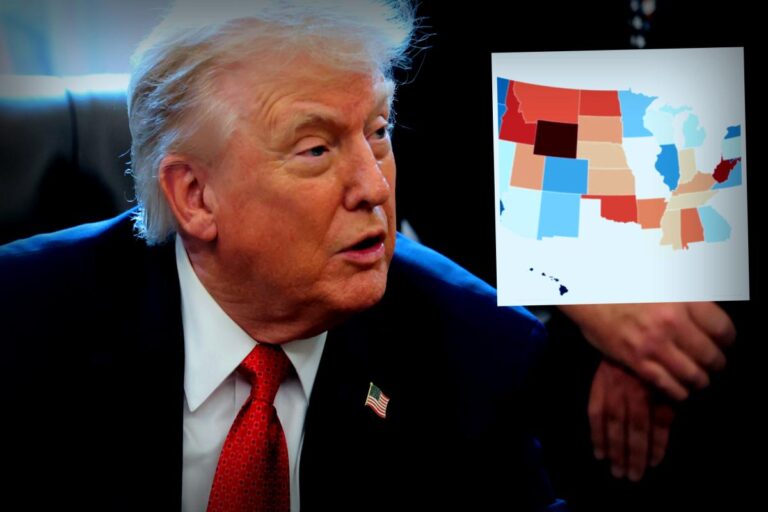



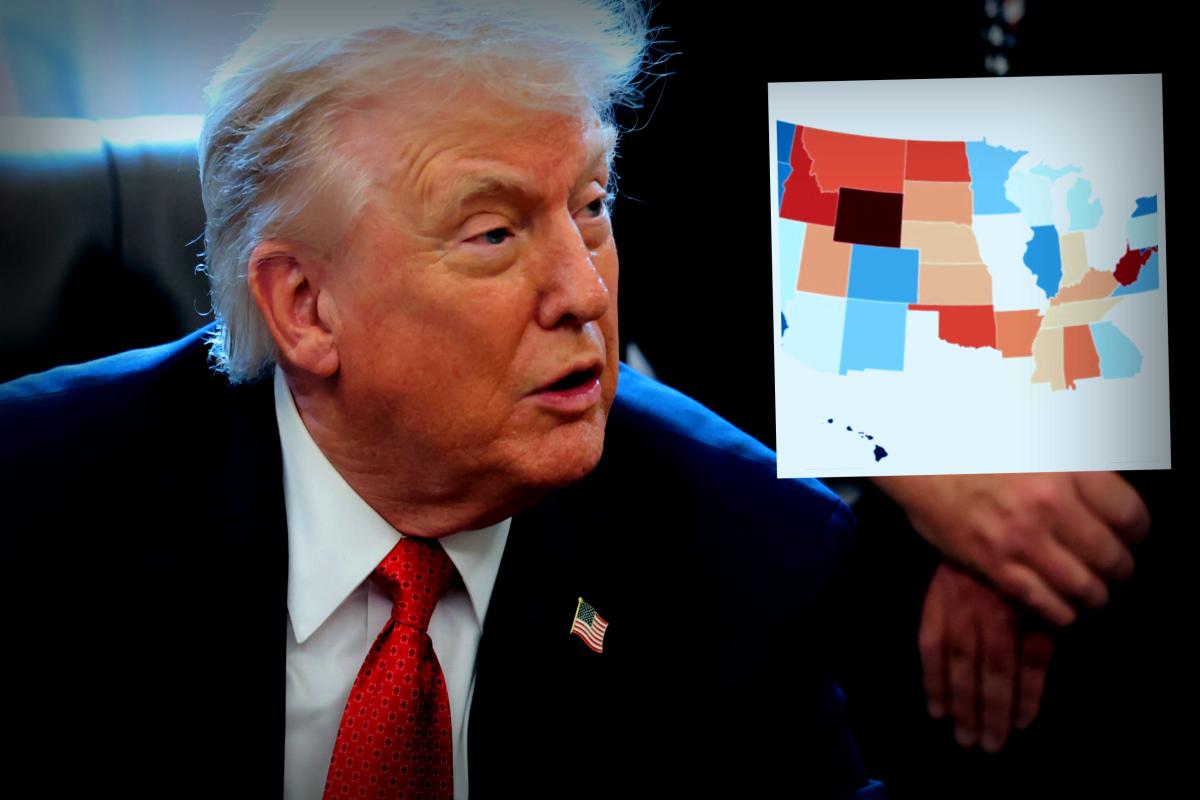
A recent polling map highlights the ongoing division in President Donald Trump’s approval ratings throughout the U.S. death toll, illustrating noticeable regional contrasts.
According to the newest data from Civiqs, only 40% of Americans are currently satisfied with Trump’s performance, while 56% express dissatisfaction, and 4% remain neutral.
This national approval statistic has seen minimal shifts from last month, pointing towards a steady public sentiment that is currently not in the president’s favor.
Newsweek reached out to the White House via email seeking comments regarding this trend.
Importance of These Ratings
As Trump continues into the 11th month of his second term, examining the approval rates state-by-state reveals strong loyalty in Republican territories, while he faces ongoing difficulties in Democratic states and crucial swing states. A sub-50% approval rating raises potential red flags as the country gears up for elections.
Key Takeaways
Moving into the later part of his second term, Trump’s national approval rating reflects a clearly polarized voter base. At approximately minus 16 points, Trump’s net approval barely differs from last month, signifying that most voters aren’t too impressed with his roster during his first year back.
This persistent situation showcases a clear divide in perspectives: his supporters stand strong, whilst opponents are firmly against him, leaving only a tiny fraction of undecided voters.
Trump’s highest approval rates are recorded in Wyoming where 66% endorse his performance. Additionally, states like West Virginia, Idaho, North Dakota, Montana, and Oklahoma also yield positive approvals exceeding +15 percentage points.
Other Republican-dominated states like Alabama, South Dakota, Arkansas, Kentucky, and Utah reflect similar approval vibes.
On the flip side, Trump’s approval stares down significant opposition in Democratic strongholds like Vermont, Hawaii, Maryland, Massachusetts, California, Rhode Island, Washington, Oregon, and New York — all corridors witnessing disapproval rates over -30 percentage points.

Struggles in Swing States
The politically significant swing states, which can determine the outcome of election campaigns, continue to present challenges for Trump. In Arizona, Georgia, Michigan, Nevada, Pennsylvania, Wisconsin, and North Carolina, the disapproval rates surpass approval by margins of -11% to -15%.
Even within states Trump successfully carried in past elections, such as North Carolina and Texas, there are more opponents than supporters marked at this time.
Divided by Demographics
Evaluating demographics exposes Trump’s weakest approvals, especially among young voters aged 18-34 (only 27% approve, while 68% disapprove) and those with postgraduate degrees (28% approval vs 69% disapproval).
However, he fared better among self-identified Republicans (87% approval), non-college graduates (43% approval), and seniors—who are almost evenly split on his performance.
Racial and ethnic perspectives further complicate the landscape. Trump’s approval is close to even among white voters (about 47% approve, and 49% disapprove), but he highly underperforms among communities of color. Only about 9% of Black Americans approve of his presidency, with a staggering 88% disapproving; simultaneous trends follow among Hispanic and Latino voters, where roughly one-third back Trump and two-thirds reject him.
Reactions
White House spokesman Kush Desai previously stated: “In the past year, the Trump administration has seen critical successes, bouncing back from Biden’s economic fallout: inflation is cooling, real wages are climbing, private job opportunities are growing, and significant investments are being injected into the American economy. This essential progress will continue into the next year for economic relief.”
Next Steps
With midterm elections approaching in 2026, Trump’s consistently low approval ratings across many states ramp up pressure on the Republican Party to regain control in competitive districts and connect better with swing voters. Historically, whenever a president’s approval dip under 50%, their associated party tends to experience severe setbacks in midterm elections.
This situation is steering both party strategies and predicting Congressional dynamics, signifying potential impacts borne out of the president’s policy ambitions, alongside the Republican Party’s electoral designs within Congress.