



The International Space Station (ISS) has been orbiting our planet for 25 years now.
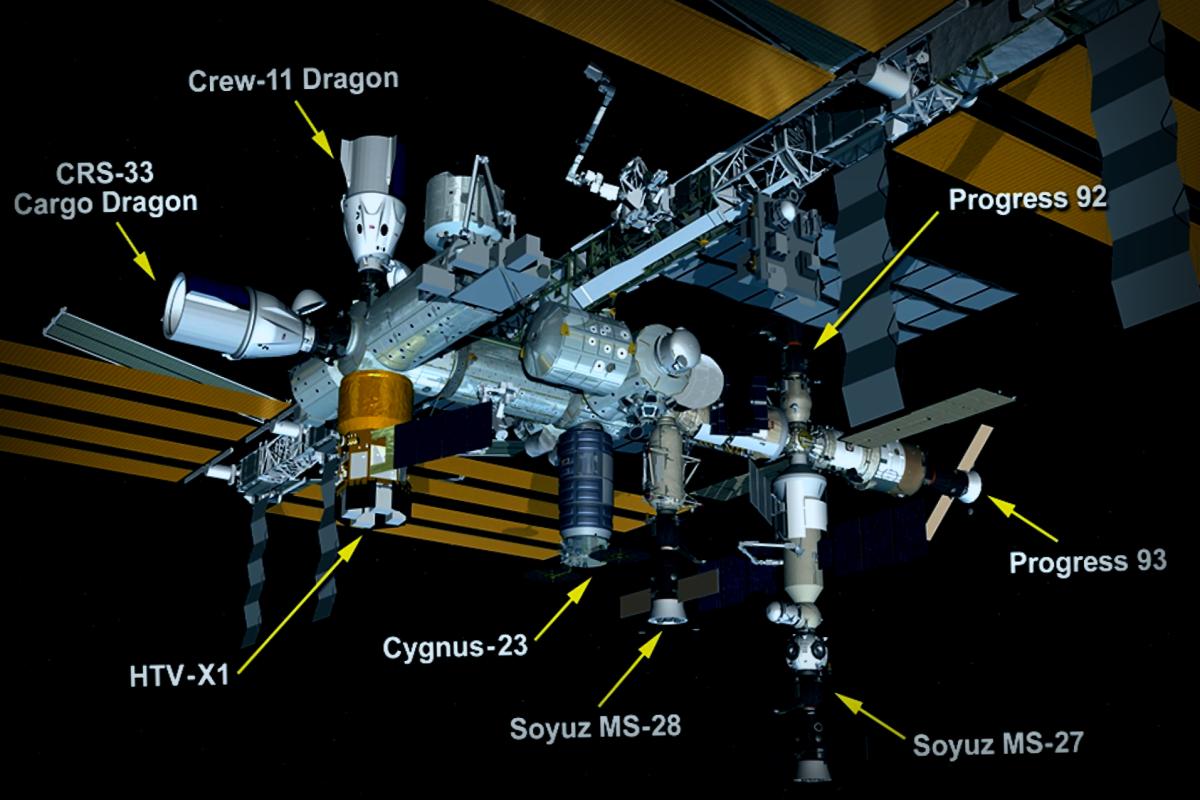
This week, it hit an impressive milestone: all eight of its docking ports were occupied at the same time.
Currently, the impressive lineup of spacecraft at the ISS includes two from SpaceX (the Dragons), a Cygnus XL from Northrop Grumman, Japan’s JAXA HTV-X1, along with two Russian Soyuz crew capsules and two Progress cargo ships.
This historical event unfolded on a Monday when the Cygnus XL was re-docked to the Earth-facing port of the Unity module.
Originally arriving at the ISS in September, the Cygnus XL made a temporary exit last month to allow a Russian Soyuz spacecraft carry a NASA astronaut together with two cosmonauts from Roscosmos to the station.
According to NASA, the coordination of the Cygnus XL’s docking involved precise planning among NASA, Northrop Grumman, and Roscosmos to ensure smooth passage for the arriving crewed Soyuz MS-28, which docked on November 27.
Expect the Cygnus to hover at the ISS until at least March 2026, after which it plans to leave and disintegrate upon entering Earth’s atmosphere, effectively disposing of around 11,000 pounds of waste.
The achievement of maxing out the docking ports for the first time indicates a shift for the space station, showcasing it as a bustling hub for international operations in low-Earth orbit and setting the stage for future orbital infrastructure.
This is promising news, especially since the ISS might wrap up its operations by 2030 due to high maintenance expenses.
Several American companies are already busy designing commercial alternatives to replace the ISS, while Russia is gearing up to launch its own habitable satellite in the next few years. Meanwhile, China continues to operate its own space station in low-Earth orbit.
If you’re curious about what life is like for astronauts on the ISS, be sure to watch these intriguing videos shared by various visitors to the station over the years.