



The International Space Station (ISS) has just achieved a remarkable milestone! With only about five years before the station leaves its orbit around Earth and is intentionally crashed into the ocean, NASA is celebrating this feat.
Since its inception on November 2, 2000, the ISS has been a hub for human activity in space. Astronauts and researchers have been conducting experiments in microgravity aboard this floating lab for over two decades. However, the adventure is set to come to a close at the end of 2030, after which the ISS will meet its end in the vast Pacific Ocean in early 2031.
The saga began in 1998, when initial modules of the ISS were launched. By the time we hit 2030, many of these components will have exceeded their intended lifespan in space by two years. It’s crucial that we decommission the ISS then, as several parts are not safe to operate beyond that point.
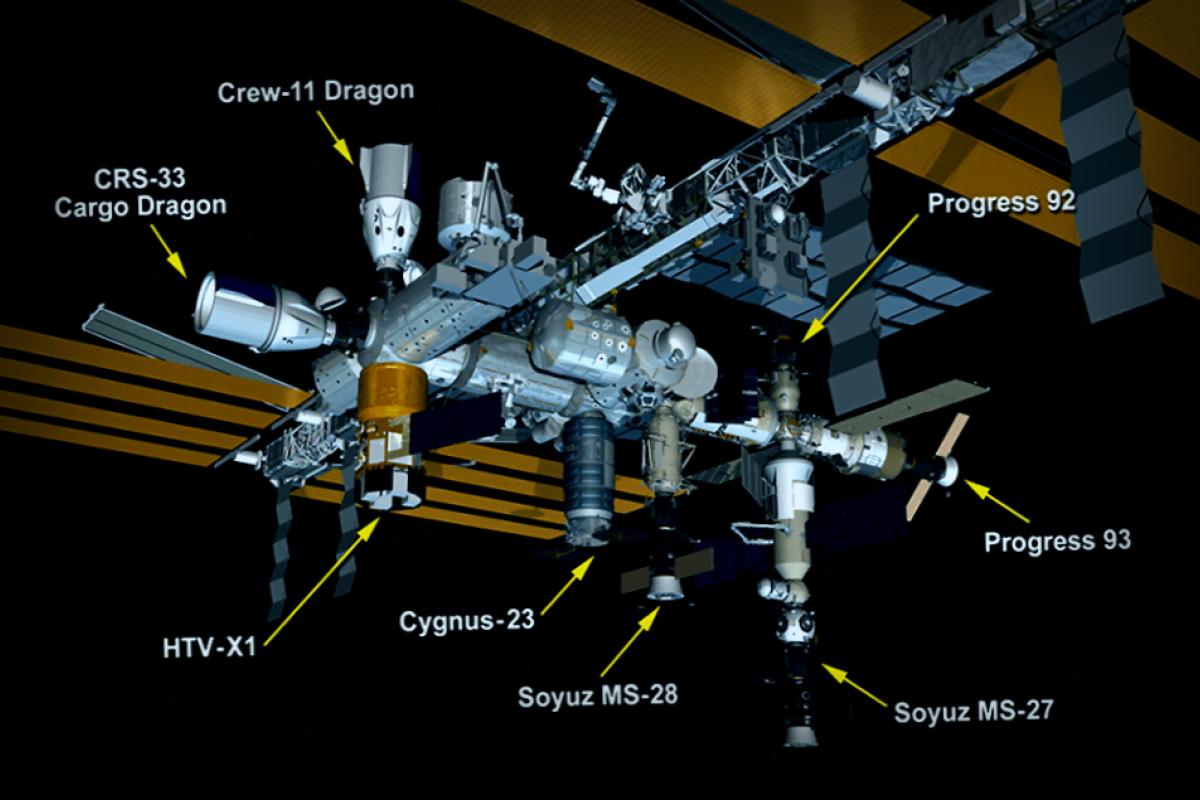
Before its grand finale, the ISS has achieved yet another historic milestone — all of its eight docking ports are currently occupied by various spacecraft!
Right now, the ISS is home to two SpaceX Dragon ships, Cygnus XL, Japan’s HTV-X1 from JAXA, along with two Soyuz and two Progress craft from Roscosmos. This is the very first time in history that every available docking port has been filled. The last to join the crew was Cygnus XL, which was remotely unlatched by the robotics officer back at NASA’s Mission Control in Houston using a robotic arm.
However, this busy scene won’t last long, as the routine operations continue leading up to the ISS’s return to Earth in just five years.
NASA stated, “Cygnus will stay attached to the space station until at least March 2026 when it’s scheduled to leave the orbit and safely incinerate about 11,000 pounds of unnecessary cargo upon re-entering Earth’s atmosphere.”
Meanwhile, the ten-member crew aboard Expedition 73 have been busy with engaging research into biology and physics, preparing for a crew rotation next week.
Three new crew members arrived last Thursday via Soyuz MS-28. NASA astronaut Chris Williams and Roscosmos astronauts Sergey Kud-Sverchkov and Sergei Mikaev will all be aboard until July 2026, pushing forward exciting advancements in how humans adapt to life in space. Kud-Sverchkov and Mikaev are already studying the effects of microgravity on their body’s circulatory system.
Once the ISS is retired, it is unlikely there will be a direct replacement. Instead, there are plans for multiple commercial space stations, including the upcoming Lunar Gateway, as NASA turns its focus toward the Artemis missions.
One notable commercial project supported by NASA is Vast’s Haven-1, anticipated to launch in May 2026. This crewed station will be smaller than the ISS, accommodating around 45 cubic meters as opposed to the ISS’s 900 cubic meters.
As the current crew conducts experiments that can only happen in a space environment, NASA and its international partners remain committed to making the most of their time aboard this legendary space station. Just next week, the station will see a shift back to seven crew members, forming the new Expedition 74 when three astronauts head back home on December 8.
Support Science Journalism. Subscribe Today!