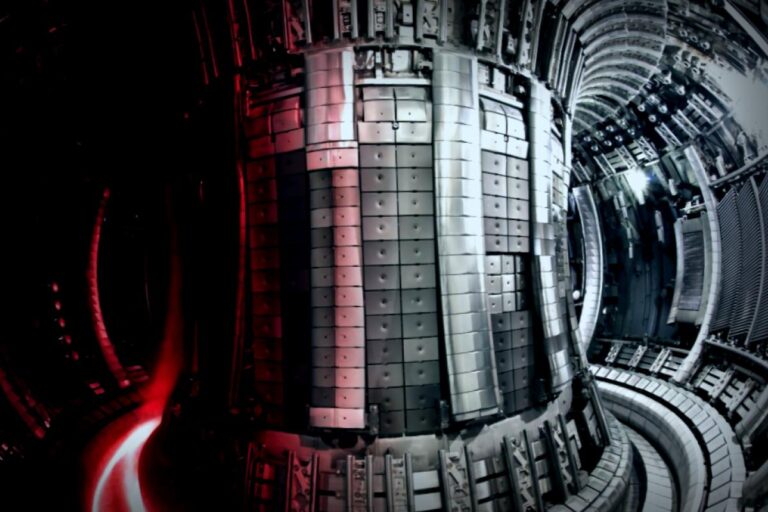


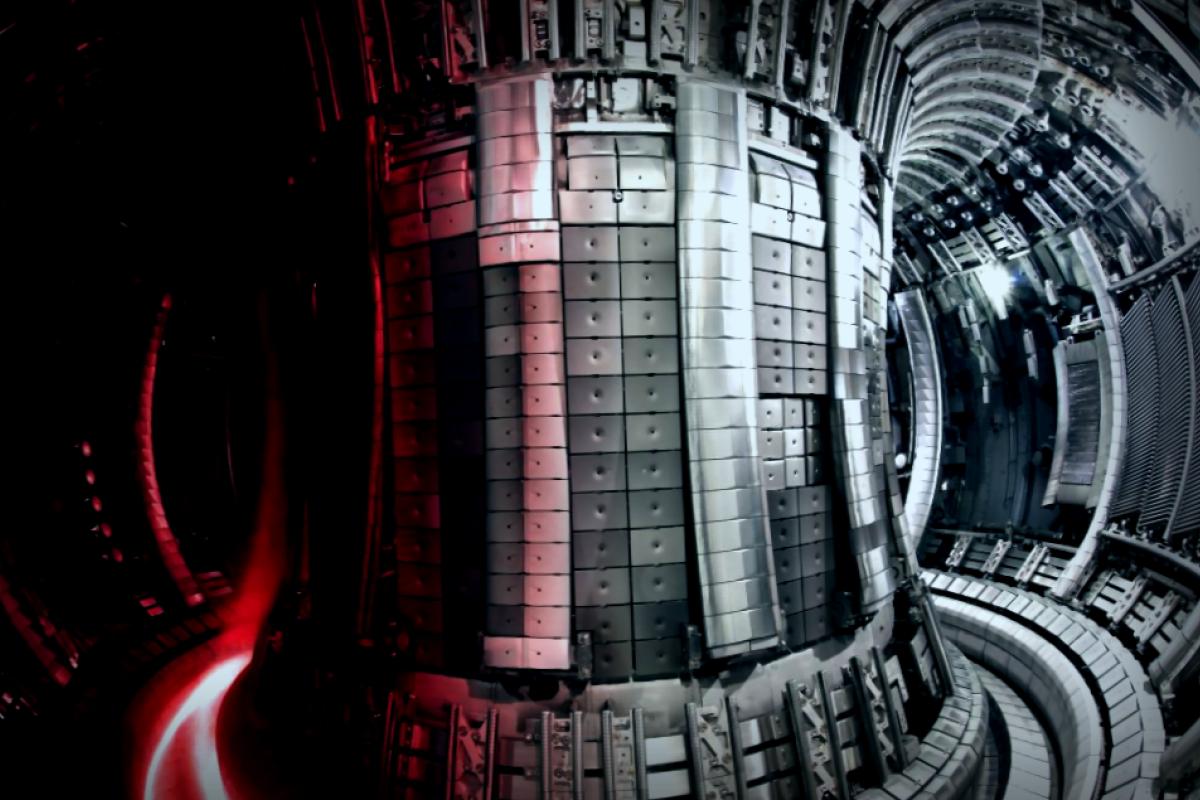
It turns out fusion reactors, designed for energy production, might have an exciting unexpected benefit. A collaborative effort by an international group of scientists has suggested that these facilities could produce low-mass dark matter candidates like the theorized axion.
They’re not just spillovers from the fusion process itself, but formed when high-energy neutrons collide with the walls of the reactor. This idea challenges what we previously thought was impossible, opening up a real pathway for future research.
Check this out:Korean Fusion Reactor Sets New Record For Sustaining 100 Million Degree Plasma
Dark matter is one of those big puzzle pieces in astrophysics. The visible matter we can actually detect just isn’t enough to account for the gravity binding everything in the universe. There’s something out there that we can’t see, which makes up about 84% of all matter, and we call it dark matter.
Traditional matter only constitutes around 16% of the universe, raising a ton of questions about what this unseen component could be. Some theories suggest it might be things like microscopic black holes, weakly interacting massive particles, or even axions, which are gaining popularity among potential candidates.
While the idea that axions could be generated from stellar fusion has been around, the focus has typically been elsewhere. Various mechanisms have been suggested for axion production, and it was assumed that it couldn’t happen effectively in fusion reactors.
However, there’s a hitch: previous estimates suggest that the expected axion output from stars is far too low to be detected easily, making it sound like a lost cause.
Interestingly, Jure Zupan and his colleagues noted a similar concept was actually discussed in the sitcom The Big Bang Theory, where characters Sheldon Cooper and Leonard Hofstadter imagined axions defined in plasma—but, sadly, that wouldn’t produce enough flux.
Instead of dabbling with plasma, Zupan’s team decided to explore neutron interactions with the lithium in a fusion reactor’s breeding blanket. Let’s break it down. In a deuterium-tritium fusion setup, there’s this thicker layer of lithium-saturated material that surrounds the core—the purpose of which is two-fold. While plasma generates intense energetic neutrons, those neutrons bash into the breeding blanket, transforming their kinetic energy into this usable heat for power generation.
Also pivotal is the lithium: when hit by neutrons, it fragments into tritium and helium, allowing the reactor to self-fuel. That’s why it’s called a breeding blanket—it’s all about producing that tritium.

The nifty consequences of neutron-lithium interactions could result in new particle production, including axions through innovative neutron-capturing reactions or the energy released due to the slowing process of scatter, known as neutron bremsstrahlung. Their calculations reveal that, in fact, more axion-like particles could be minted from these processes than fusion itself, with a likelihood of detecting them beyond the reactor walls.
According to Zupan, “The Sun has a vast capacity to produce particles that have a chance of reaching Earth, but performance in reactors, driven by distinct processes, should not be dismissed.”
This fascinating research not only adds depth to our understanding of dark matter but also strikes a new chord in the experimental search for it. The work is documented in the Journal of High Energy Physics.